How “Blaming The Victim” Is Good For Society

As some of you may know, I am still (unfortunately) in the military.  You also may know that “sexual assault” has become the military’s latest hot-button issue.  As a result, we have all been subjected to endless “training sessions” on how not to rape somebody.  The DoD, in its infinite wisdom, seems to be convinced that the main reason there’s so much rape in the military is that we haven’t been told not to rape people enough times.

This weekend, they gathered us all together in a large room for the latest “training session” which included a 45-minute video.  They must have spent a lot of time and money on this thing, because it was pretty polished and well written and acted compared to other training videos.  The video is a long scenario explaining a common way that sexual assaults happen in the military, how they might be prevented, and what the consequences are.  There are pauses for the instructors to “engage in discussion” with the troops, including specific questions they are supposed to ask and points they are supposed to emphasize.

One of the most commonly stressed and emphasized points is:  Do not blame the victim.  This is repeated over and over again.  The message is that sexual assault in general (and I’ll expand this to any crime that may be committed against someone actually) is completely and totally not the “fault” of the victim.  The video highlights many instances in which bystanders might have intervened to prevent the sexual assault.  However, at no point do they draw attention to anything the alleged victim might have done to reduce their odds of being assaulted.  All of our trainings seem to take this route, and I think it’s symptomatic of a greater problem in society – the issue of how we assign “blame,” “fault,” and victimhood.

By refusing to assign any amount of blame to the victim of a crime, the implication is that there was absolutely nothing they could have done to prevent the crime.  Almost always, this is not the case.  Precautions could have been taken.  In the particular video we watched, where we are assured the victim is not to blame, I identified six different things the victim did that, had she behaved differently, might have prevented her from being assaulted.  First, she felt harassed and intimidated by one of her co-workers, and did not report it.  Second, she attended a party where she knew alcohol would be served, and she knew that this co-worker would be present.  Third, she attended this party without bringing a friend to stay with her (or making anyone at the party aware of her concerns about the co-worker).  Fourth, she drank alcohol at this party.  Fifth, she drank a lot of alcohol at this party.  Sixth, she willingly left the party with the co-worker she was suspicious of.

Now, let me just take a moment and make it perfectly clear.  None of these behaviors make it “okay” to sexually assault someone.  None of these things excuse the awful actions of the perpetrator, who committed an act of aggression against an unwilling participant.

That said, by having committed six different actions that increased her likelihood of being assaulted, I do in fact think that the victim is partially to blame.  I think in these situations that we can distinguish between “blame” and “fault.”  I see blame as a basically infinite pool of negative emotions.  Anyone who could have taken any action to prevent this assault, and didn’t, is partially to blame for it having taken place, including the victim.  Fault, on the other hand, I see as a more fixed amount.  The perpetrator is primarily at fault, in all cases.  I would not say that it is the victim’s “fault” that she was assaulted, nor would I suggest that any of her actions excuse any of the perpetrator’s behavior.

I view “blame” as a social construct, designed to elicit the negative emotions of guilt and embarrassment.  This can be an incredibly useful tool, both for individuals, and for society as a whole.  Much like how pain is the brain’s method of telling the body that something really bad is going on, blame is society’s method of telling individuals that their behavior is putting themselves and others at risk.  Without pain, we would not bother to take our hand off a hot stove until significant damage had been done.  Without blame, we wouldn’t bother to learn from the mistakes of ourselves, and others.

Imagine that a friend of yours was seriously injured in an auto accident.  You would be upset and confused.  You would immediately want to know who was at fault, and who was to blame.  Perhaps the next day you find out that the driver of the other car had been intoxicated during the collision.  Now you have your answer.  Your friend was hit by a drunk driver.  It wasn’t his fault.  However, what if the next day, you find out that your friend hadn’t been wearing his seat belt?  And that he had been speeding?  And that his air-bag failed to deploy because it needed to be serviced, which your friend never bothered with?  And that your friend had the bare minimum legally required auto insurance, which was unlikely to fully repay the cost of his injuries?  Does any of this change your perception of who is to blame for the situation as a whole?  Do you start to consider that your friend (although still not at fault) is at least somewhat to blame for his situation?  Do others learn a valuable lesson about the importance of not speeding, buckling your seat belt, having your air-bag serviced, and purchasing good insurance?

You can bet that the victim in this training video learned some valuable lessons from her experience (note once again, that does not mean the experience was good, justified, or some type of blessing in disguise).  At one point during the “aftermath” segment, she even stares into the camera and says “I’m a lot wiser now.”  But why?  Why is she wiser?  If she is a victim and her own behavior had nothing to do with the assault, what possible lesson could she learn?  What wisdom is to be gained?

There are constant pushes by various malignant forces in society to convince the human race that we are all victims.  That anything bad that ever happens is a result of random chance, or of external forces totally beyond our control.  A society obsessed with “victimhood,” combined with a prevailing ethos of “don’t blame the victim” produces a society of individuals willing to accept adverse circumstances, and who believe there is nothing at all to be learned from them.  It produces a society where meek compliance is seen as the highest virtue.  It produces a society that is absolutely ideal… if you’re a tyrant wanting a society you can easily control and exploit.  We should challenge these premises of victimhood wherever we see them.  Even in uncomfortable situations like sexual assault.  Undoubtedly, the victim in this sexual assault training video was told by her counselors that she was not to blame for this assault.  These counselors did her a disservice, and intuitively, she knew it.  Though it may be difficult to admit, the victim often shares in the blame.  It is time we confront this boldly and honestly, rather than continuing to believe that we are all just victims of circumstance.

Posted in General Theory | Tagged , , , , , , | Leave a comment

“Record Profits” Are Good, Should Be Normal

maximizing-profitsOne of the most oft-repeated canards by socialists when they’re losing an argument is how companies are making “record profits.”  Most of society has been brainwashed into automatically assuming this is somehow a terrible thing that must be quickly remedied.  How dare they make record profits?  How much more greedy can you be?  This idiotic complaint tends to enrage me more than any other, because it is just so unbelievably stupid.

Let me state this clearly, and without any reservation.

All other things being equal, every company should expect to make record profits every year.

Let’s think about this for a minute.  What does it mean to make “record profits?”  It means simply that a company made more money in its most recent fiscal year than it did in any year previous.  Putting aside whether corporate profits in and of themselves are good or evil, should we not expect this to occur?  Due to inflation (even when inflation is very minor, it still exists), a company that retains the exact same amount of business from year to year will see “record profits” every single year (assuming we are speaking of nominal profits).  Due to the fact that most firms retain most of their profits to re-invest in their businesses, we should expect that these re-investments cause the firm to grow, and therefore make even more profits.  In the normal course of affairs, every company should make “record profits” every year.  Any firm that is not making record profits has either been the victim of a business cycle (most likely created by the federal reserve) or is being run quite poorly, in which case investors should demand a change in management.

As an aside, let us think about an individual worker rather than a corporation.  Individuals sell their labor in the same method that corporations sell goods and services.  A thrifty person will work hard to earn more money than he spends, thus putting some aside from savings.  This savings represents profit, in the sense that it equates to the revenue the person has taken in, minus the expenses of items they have purchased.  Normally, virtually everyone expects to make “record profits” every year.  The average employee would expect (and quite reasonably so) that with every year of work experience; they make themselves more valuable, thereby increasing their revenues.  They might also expect that as they purchase capital goods, such as a car, a house, or education, that these goods will enhance their productivity, or at least not need to be purchased again, thus lowering their expenses.  Now obviously, someone might occasionally manage their life poorly and get fired from a job, or they might be a victim of circumstances beyond their control leading to a layoff, but those would be exceptions.  In the general course of affairs, they would expect to make record profits every year.

The next time a socialist complains about “record profits,” ask them if they are making more money this year than they did last year?  If not, ask them if they ever plan on making more money than they currently are at any point in the future.  That would be record profits.  In the regular course of affairs, every company should expect to (and usually succeed in doing so) make record profits every year.  This is simple economics.  It is not a villainous act that should be condemned, but rather, it results in tremendous  progress and an improved quality of life for humanity as a whole.

Posted in General Theory | Tagged , , , , , | Leave a comment

Health Care Markets Aren’t Special

The laws of economics are universal.  Socialists often try to dispute them, or to muddle the issue by injecting questions of morality into debates over economics.  Previously, we debunked several myths regarding the economics of labor markets.  Today, we address an area of the economy where moral judgments are passed off as sound economics on a regular basis:  health care.

One simple fact that the moralists (typically on the left) refuse to admit is that medical care (whether we’re discussing physical goods such as medications or services such as the diagnostic expertise of a skilled professional) is a good available for exchange just like any other.  The fact that this good has a dramatic effect on the length of one’s life is not relevant, from an economic perspective.  Many other goods can also affect the length of one’s life, such as food, transportation, machinery, etc.  Let’s review some of the fallacies surrounding the economics of health care:

1.  Length of life is the absolute.  This one is pretty easy to disprove.  We can easily imagine a scenario in which case quality of life takes precedence over length of life.  Let’s say you are visited by a genie who offers to extend your life by one year, but in exchange, you must live the rest of your days in concentration camp-like conditions.  Does anyone accept this deal?  Probably not.  On a similar token, we make such decisions on a daily basis.  The decision to smoke cigarettes, or eat unhealthy foods, for example.  Virtually everyone who smokes or eats poorly knows that doing so threatens their health and decreases their potential life-span.  Yet, many choose to engage in these activities anyway, because they’d prefer to live a shorter life full of pleasures than a longer life of austerity.  The same decisions can be made financially.  Someone may choose not to purchase a particular medication or treatment (which would enhance their length of life), because they would rather spend the money on taking a vacation (which would enhance the quality of their life).  Generally speaking, length of life and quality of life are competing forces, if for no other reason than the fact that medical care costs money (regardless of whether you pay directly in cash, or indirectly through employer or government provided insurance).  Occasionally, medical care addresses quality of life issues independent of length of life.  Severe headaches, for example, might lessen one’s quality of life tremendously but not present any substantial long-term health risks.  In this case, the decision comes down to a simple financial weighting of choices like any other.  Would you prefer to spend your money reducing your headaches, or on other goods and services you might enjoy?  Simple economics applies.

2.  People “need” medical care, but not other things.  Usually you see this concept brought up by those who like to refer to medical care as a “right.”  The classic spin goes:  Someone’s need for medical care supersedes someone else’s need for “luxury” items (entertainment, electronics, travel, etc.).  Therefore society is justified in taking the money of anyone who already has everything they “need” and spending it on the medical care of those who cannot afford it.  This is most easily disproved by pointing out that “need” is completely and totally subjective.  Aside from that, we must keep in mind the point of the previous paragraph.  It is entirely possible that someone is making a conscious decision to go without medical care, because they would prefer other things.  By declaring medical care an absolute right that cannot be denied, you incentivize people to refuse to spend any money on it, regardless of whether they can afford to.  Why should I sacrifice my vacation to receive medical treatment when I can just spend the money for my vacation, claim poverty afterwards, and receive the treatment anyway?  I suppose we could set up some elaborate means-testing program to determine who really “needs” medical care and who is just deciding not to purchase it, but such a program would be difficult to manage, incredibly inefficient, and likely a huge target for massive fraud.  Nobody has a right to decide what someone does and doesn’t “need” but the individual themselves.

3.  Ability to pay should not restrict access to medical care.  This is essentially a subset of the last point.  Another way to put this (but nobody in favor of socialized medicine ever does, because they recognize how ridiculous it sounds) is that cost should be completely irrelevant to medical decisions.  Spare no expense!  Money is no object!  People’s lives are in the balance here!  Of course, paragraph #1 demonstrated that when faced with the decision personally, money absolutely is an object, and we can further prove this through a hypothetical scenario.  Imagine a 75-year-old homeless person with no friends or family who suffers from cancer and is in a lot of pain (to prevent this from becoming a question of assisted suicide, let’s assume that despite the pain, they are adamant that they want to live) is admitted to a hospital and is on the verge of death.  There is an operation that can save the person from immediate death, but the odds of survival for any longer than six months are less than 10%.  This operation costs $500 million.  Should the government pay for this operation?  If you had to think about this at all and you are willing to even entertain the thought that the answer might be no, then congratulations:  you officially support death panels, and you acknowledge that traditional cost-benefit analysis can in fact be applied to medical care.  For another hypothetical scenario, imagine you walk into a restaurant.  The waiter attempts to give you a menu, but you refuse it.  Instead, you hand him your credit card and say, “Good man, you are the expert here in matters of food, not I.  Since food is vital to survival, no expense is too great!  Bring me your absolute finest food, in whatever quantity you believe I need, and feel free to tip yourself whatever amount you deem appropriate.”  Do you expect to get a good value from this restaurant?  Does this sound like a wise plan?  And yet, this is essentially the exact plan that socialized medicine embraces.  Empower the doctors to do whatever they want, with the full knowledge that nobody involved cares about the expenses at all.

There are probably more fallacies out there regarding the economics of health care, but this is all that comes to mind at the moment.  If you’d like to dispute some of my analysis, or if you have a fallacy I may have forgotten, please let me know on Facebook or in the comments.

Posted in General Theory | Tagged , , , , , , | 1 Comment

The Income Tax: Root Of All Evil – Frank Chodorov (Selected Quotations)

I recently took a course on Mises Academy taught by Tom DiLorenzo regarding the economic nationalism of Hamilton, Clay, and Lincoln.  In the final week, one of the assigned readings consisted of a few chapters of this book (available for free online at mises.org).  Instead of the few assigned chapters, I read the whole thing (it’s rather short, only about 90 pages) and was quite impressed.  Despite being written in the 1950s, everything Chodorov says in this book is still applicable today.  Throughout the book, various small selections were emphasized in either bold or italics, and I found myself noticing how these selections were in fact quite profound and mostly able to stand completely on their own.  So I decided to present them here, as little pearls of wisdom.  Enjoy!

The Constitution, then, is held in high esteem only because of the high esteem Americans put upon the doctrine of natural rights.  Any law, political practice, or even amendment that infringes those rights is automatically deemed “unconstitutional.”  The infringement is “evil.” p4

A people who are intent on getting something-for-nothing from government cannot cavil over the infringement of their rights by that government. –p5

This treatise on the Sixteenth Amendment will proceed under these general lines:  That as a consequence of this law our government is being transformed into one alien to the American tradition.  That social and individual values are likewise undergoing transmutation.  That, in short, America is no longer the America of the Declaration of Independence.  Finally, and most important, we shall suggest a means for reversing the trend and restoring the “good” of our tradition. – p6

All indirect taxes are added to price.  – p7

Income and inheritance taxes imply the denial of private property, and in that are different in principle from all other taxes. – p8

In short, when this amendment became part of the Constitution, in 1913, the absolute right of property in the United States was violated. – p9

All socialists, beginning with Karl Marx, have advocated income taxation, the heavier the better. – p9

The individual has an inalienable right to his property. – p10

The basic axiom of socialism, in all its forms, is that might is right. – p11

Therefore, when you cause these things to exist, your title to yourself, your labor, is extended to the things.  You have a right to them simply because you have a right to life. – p12

In other words, your ownership, entitles you to use your judgment as to what you will do with the product of your labor – consume it, give it away, sell it, save it.  Freedom of disposition is the substance of property rights. – p13

Therefore, the general production of a socialistic society must tend to decline to the point of mere subsistence. – p14

The income tax is not only a tax; it is an instrument that has the potentiality of destroying a society of humans. – p14

The contemplated government would simply be the foreign department of the several states. – p16

Every war is fought with current wealth. – p18

We pay as we fight. – p18

The bondholder is simply a partner of the tax collector. – p18

Since all bonds are claims on production, what really happens when bonds are issued is – let’s call it by its right name – counterfeiting; the amount of purchasing power, or money, is increased. – p19

Government borrows on its ability to tax, because taxes are the only source of its revenue, the only security it has to offer the lender. – p19

The ability-to-pay doctrine proceeds from a direct violation of this principle of equality.  It establishes a legal classification of society.  It sets up a principle of government that was not contemplated when this nation was formed; it is a reversion to the caste system that had existed in Europe. – p20

The advocates of ability-to-pay; however, do not distinguish between wealth obtained by production and wealth obtained by privilege. – p21

People make wealth; government can only take it. – p22

Hence, the effect of income taxation is to impair the capital structure of the country. – p22

The income tax therefore hurts the wage earner to a far greater extent than by what is filched from his pay envelope. – p22

When all the capital in the country is in the hands of the government, then all of us must work for the government under the conditions it prescribes – and that is slavery. – p23

Income taxation appeals to the governing class because in its everlasting urgency for power it needs money. – p26

Income taxation appeals to the mass of the people because it gives expression to their envy; it salves their sense of hurt. – p27

So that, the sum of all arguments for income taxation comes to political ambition and the sin of covetousness. – p27

The end product of government intervention in the economy of the country is more power for government. – p28

In name, it was a tax reform.  In point of fact, it was a revolution.  For the Sixteenth Amendment corroded the American concept of natural rights; ultimately reduced the American citizen to a status of subject, so much so that he is not aware of it; enhanced Executive power to the point of reducing Congress to innocuity; and enabled the central government to bribe the states, once independent units, into subservience.  No kingship in the history of the world has ever exercised more power than our Presidency, or had more of the people’s wealth at its disposal.  We have retained the forms and phrases of a republic, but in reality we are living under an oligarchy, not of courtesans, but of bureaucrats. – p32

Thus, the immunities of property, body and mind have been undermined by the Sixteenth Amendment.  The freedoms won by Americans in 1776 were lost in the revolution of 1913. – p35

The poor, simply because there are more of them, have more ability to pay than the rich. – p37

Every cent taken from wages is thrown into the till of the United States Treasury, and is spent for anything the government decides upon.  So, too, are the “contributions” from the employer.  That is to say, social-security taxes are taxes, pure and simple; they are “forced dues and charges” levied by the sovereign on his subjects for the expenses of the state.  None of the money is held in reserve, none of it is invested in business.  All is spent, and it is spent long before the “insured” is entitled to benefits. – p37

So that, in effect, the children are supporting their parents collectively, and without love. – p38

The employer must include in his expenses what he is compelled to “contribute.”  This expense shows up in the price of his goods, and the wage earner, as consumer, actually pays it. – p38

The money taken from the worker’s pay envelope is worth more, will buy more goods, than the money he will get when he is old, simply because these bonds are in existence. – p38

It wanted more taxes, and it dipped further into the pay envelope; that is the real purpose of the social security laws. – p39

The government will meet its obligations by handing out brand-new printed dollars, with declining purchasing power, and the old folks will have to depend on what support they can beg from their tax-ridden children. – p39

When the individual is relieved of the obligation of self-respect, he acquires the habits of helplessness; he is inclined to retreat to the security of the prenatal state.  The more he is taken care of the more he wants care. – p41

In Germany, the social-security philosophy of government led to the moral decadence which facilitated the advent of Hitler.  In England, it made a once-proud people into a nation of panhandlers.  What will it do to America? – p42

But while the private spendthrift is held in leash by the threat of bankruptcy, government is unhampered by any such fear; it can print money or something equivalent to money, and compel citizens and banks to accept this paper in payment for its debts; it can rob its subjects by the trick of inflation, and thus make up for its overspending. – p43

The main point is that the Sixteenth Amendment has widened the area of government power, and as a consequence has reduced the area of liberty. – p43

It is written into our consciousness that “mine is mine” and all the tomes in support of income taxation cannot wipe out that thought. – p45

All taxes come from production. – p46

The corruption is written into the law. – p47

It has the means of harassing, intimidating, and crushing the citizen who falls into its disfavor. – p48

Practically every textbook used in our college economics courses proclaims the virtue of progressive income taxation as a means of “distributing wealth.” – p50

The so-called lobbying law has had the effect of bribing Americans into abandoning their right of protest. – p51

The corruption of freedom is in proportion to the moral deterioration of the people.  For a people who have lost their sense of self-respect have no need for freedom.  And the income tax, by transferring the property of earners to the State, has disintegrated the moral fiber of American to such a degree that they do not even recognize the fact. – p52

The income tax, by attacking the dignity of the individual at the very base, has led to the practice of perjury, fraud, deception, and bribery.  Avoidance or evasion of the levies has become the great American game, and talents of the highest order are employed in the effort to save something from the clutches of the State.  People who in the private lives are above reproach will resort to the meanest devices to effect some saving and will even brag of their ingenuity.  The necessity of trying to get along under the income tax has made us a corrupt people. – p52

The business he is in, politics, drives the politician toward the acquisition of more and more power, and a good politician is one who takes advantage of every contingency to increase his power. – p55

We will ask for a savior and we will get communism. – p56

In no country where centralism got going did the regime have to contend with divided authority such as our Constitution provides. – p58

Divided authority is the bulwark of freedom. – p60

Freedom is the absence of restraint.  Government cannot give freedom, it can only take it away.  The more power the government exercises the less freedom the people will enjoy.  And when government has a monopoly of power the people have no freedom.  That is the definition of absolutism – monopoly of power. – p60

Throughout history, those to whom the job of rulership has fallen, whether by hereditary or popular selection, have shown a tendency to use their position to dominate, not serve, the ruled. – p61

Popular suffrage is in itself no guarantee of freedom.  People can vote themselves into slavery. – p61

As long as anything is left of our tradition of States’ Rights, the danger of absolutism in this country can be avoided.  In fact, it is that tradition that must be depended upon in any effort to repeal the Sixteenth Amendment. – p63

After 1913, however, and without either a war or a change in the law of the land, the states were gradually and almost imperceptibly rid of their sovereign position and reduced in importance to dependent subdivision of the nation.  It was done by the subtle arts of bribery and blackmail, made possible by the Sixteenth Amendment. – p64

Before 1913, the country was in difficulty several times, but it never suffered from an “emergency”; that national disease is a product of the income tax, and as the levies increased, the affliction recurred with greater frequency and greater intensity. – p65

The odd thing about these “emergency” taxes is that they hang on after the original occasion for them disappears. – p65

The first concern of a politician is to be elected, the second is to be reelected. – p66

The practice of buying votes with political favors is inherent in popular government.  It is the weakness of democracy.  It is not due so much to the depravity of the politician as to the human hunger for something-for-nothing. – p66

Thus, every federal dollar spent in a state becomes an obligation on the state.  The obligation is paid off with sovereignty; the state sells out its independence.  It is all done without change of the law, without any modification of the Constitution, and is as imperceptible as the gradual wearing down of a proud horse by a resolute trainer. – p67

But the fact that every state is now a loser gives them all a common interest in the repeal of the Amendment. – p68

The only group that could logically furnish that leadership are the governors and legislators of the states. – p70

Repeal of the Sixteenth Amendment would amount to secession of the forty-eight states from Washington – and restoration of the Union. – p71

As a result of income taxation, we now have a government with far more power than George III ever exercised.  It is self-sufficient, independent of the will of the people.  The elections do not alter that fact; they are merely periodic changes of the guard.  Whoever is elected retains the power vested in the office and, as usual, tries to augment it.  The end in clear sight is the liquidation of all social power and the advent of a regime of absolutism.  – p75

Unless Americans want to be free, unless they put their tradition of freedom above all else, the Sixteenth Amendment will stay in the Constitution until it wrecks both the tradition and the civilization from which it emerged. – p75

The straight-thinking pioneer knew full well that the power of the government is in direct ratio to its income, and he was therefore all for cutting its income to the bone; that way it could not get out of hand. – p76

The case for repeal rests on this tradition.  If there are still enough Americans who are of the opinion that the government governs best which governs least, if there is among us a group willing to risk their fortunes, their lives, and their sacred honor for freedom, then repeal has a chance.  If, on the other hand, the habits of mind acquired under income taxation have completed obliterated the American tradition, then any effort to restore citizen sovereignty is futile. – p77


Posted in Quotes | Tagged , , , , | Leave a comment

News Roundup – 2/15/2013

RonPaul.com – The LRC Blog

I’m sure most of you have already read Lew Rockwell’s explanation of the whole RonPaul.com drama, but just in case you haven’t, here it is.  It all seems entirely plausible to me.

Fracking and Federalism

Bob Murphy points out yet another case of the left suddenly becoming big fans of small, local government.  It only occurs when the small, local government does something they like (in this case, banning fracking).

Medicare:  A Dangerously Good Deal – The Motley Fool

The Motley Fool’s statist-in-chief declares that medicare is a “good deal.”  Sure, in the same way that a mugging is a “good deal” for the mugger.  It’s always a good deal when the government steals money from other people and spends it on you.  Fortunately, David and I are already on the case in the comments section.

Jeffrey Tucker on Capitalism and McFish

Jeffrey Tucker made a brilliant Facebook post discussing how the McFish symbolizes the superiority of the free market to government.  Not sure if the link will work if you haven’t already “liked” him.  But why wouldn’t you?  What’s not to like?

Posted in News Roundup | Tagged , , , , , , , , , , , , , , | Leave a comment

Government Sues Monopoly It Created

Last week, the federal government announced its intention to sue S&P over the ratings of various mortgage-backed securities leading up to the housing crisis.  While I could provide any number of examples of various members of the government and the federal reserve making the same mistake, that is not exactly the point of this post.

The point of this post is to remind everyone that S&P (along with Moodys and Fitch) was granted (and continues to enjoy) a monopoly in bond rating services (technically I guess this forms a tri-opoly, but the point still stands).  Regardless of party affiliation or economic school, everyone basically agrees that monopolies are bad, and that competition is good, as it improves the quality of available services.  Except in certain specific cases, the government insists to us that a monopoly is necessary.  For our own good.

Now of course the government is shocked, just shocked, that the monopoly it created did a very poor job of serving the public interest.  Why ever could that be?  Of particular interest should be the fact that at no point has the government admitted this mistake, or made any suggestion that they might consider removing this monopoly privilege and allowing free competition among rating agencies.  Instead, they are simply demanding millions of dollars of fines, and then they will allow the inefficient and incompetent rating agencies to continue to enjoy their protection.  In a free market, you wouldn’t have to sue the S&P for giving awful ratings.  They would have already collapsed after their credibility was destroyed, and more capable competitors would have taken their place.

Unfortunately, that is not a market we are allowed to have.  You know, for our own good.

Posted in News Commentary | Tagged , , , , , | 2 Comments

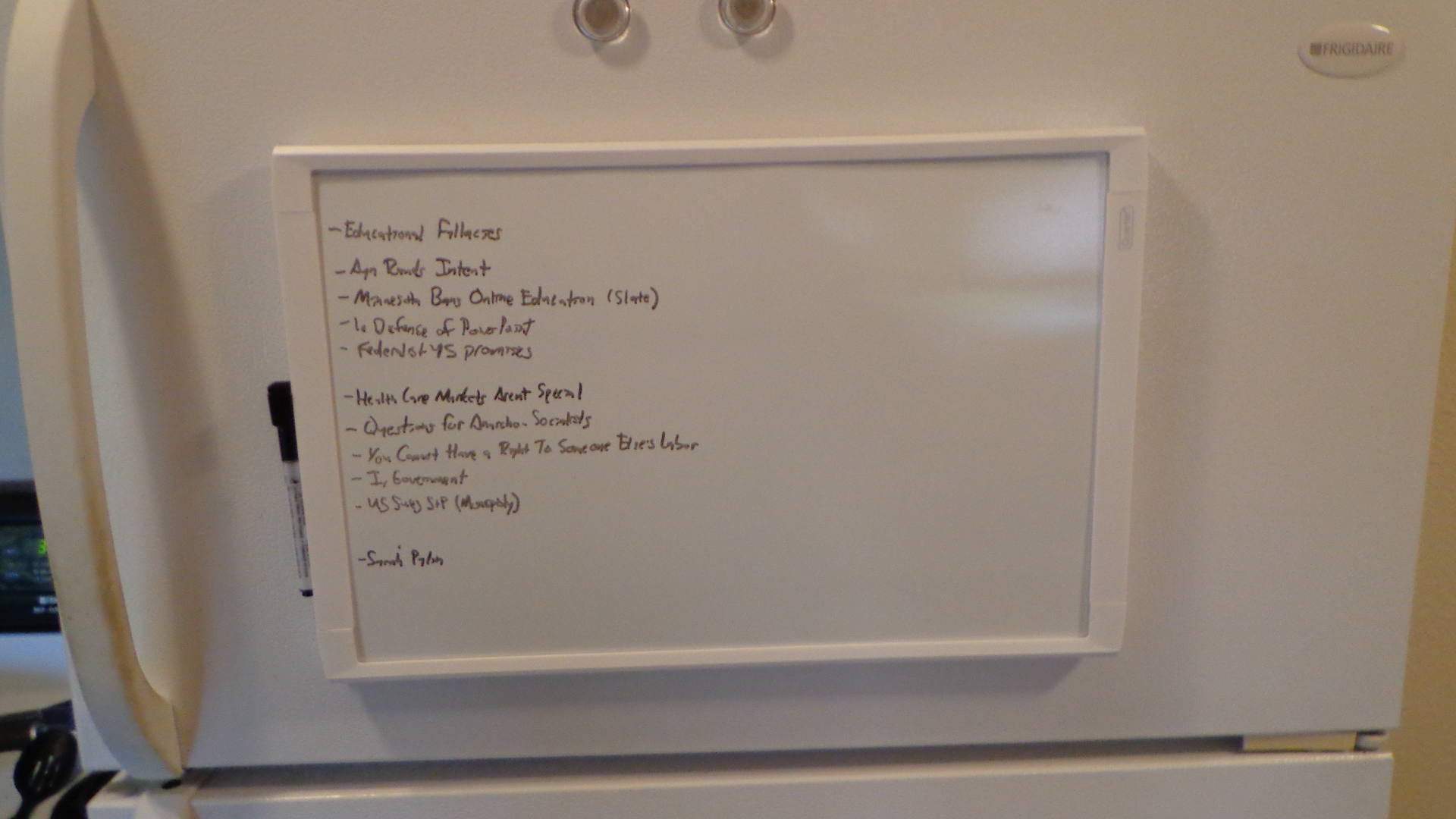
The DWMF Idea Board

Idea BoardBehold!  The DWMF “Idea Board.”  Just as some fun little insight, I thought I’d share how exactly I keep track of topics I plan on addressing in the future.  Sure, I could use a higher-tech method, but some sort of electronic file stored on my computer would only be accessed when I have cause to look at it.  By keeping this right on my refrigerator, I get reminded of these topics every time I visit the kitchen, allowing me to refine my thoughts and think about what I want to write on a near-constant basis.

Posted in General | Tagged , | Leave a comment

Peter Schiff on the CPI

A great companion to my last post… Schiff breaks down the flaws in the CPI.  I particularly love the example of newspapers and magazines, where the official government propaganda doesn’t even come close to matching the prices that are printed right on the cover.

Posted in Video Link | Tagged , , | Leave a comment

Incentives and the CPI

Note:  This post is adapted from a comment I made on David’s latest blog.

One of the most fundamental principles of economics is that people respond to incentives.  This is a basic axiom that almost no one would dispute.  From this, we can also conclude that groups of people, whether private (corporations) or public (government bureaucracies) also respond to incentives.

With this in mind, let us consider the Consumer Price Index (CPI).  The CPI is the government’s primary means of measuring inflation.  Whenever you hear a politician or a journalist claim that inflation is at such and such a percent, they are almost certainly referencing the CPI.  A detailed discussion of how the CPI is calculated is beyond the scope of this post.  Needless to say, many are quite critical of its methods and question its accuracy.  While I don’t have any sort of evidence that there is an active conspiracy to design the CPI in such a way as to under-report inflation, I would like to briefly review the incentives that government agencies might have to do so.

As the CPI is the primary measurement of “cost of living,” countless government programs, contracts, etc. are indexed to it.  Social security is indexed to the CPI.  Military pay and entitlements are indexed to the CPI, as are retirement and veterans benefits.  Many welfare programs are indexed to the CPI.  The government sells “treasury inflation-protected securities” (TIPS) that increase in value to compensate holders for inflation, as measured by the CPI.  This indexing means that these programs are designed to pay out more money to recipients in direct proportion to the rise in the CPI, in order to “keep up with the cost of living.”

How about an example?  Let’s say you are receiving social security benefits of $1000 a month.  At the end of the year, according to the CPI, the cost of living has increased by 2% (this would also be reported as inflation of 2%).  Because of this increase, your benefits will now also increase by 2%, to a total of $1020, an increase of $20.  This increase in cost of living requires the government to pay you more in benefits.  Considering how many millions of individuals receive government benefits that are indexed to the CPI, this will end up resulting in massive increases in benefits that the government must pay out.

Now, let’s consider what happens if they fudge the numbers a bit.  Not that they would of course, just a completely hypothetical what-if.  Let’s say that according to the CPI, the cost of living has increased by 2%, but in reality, the cost of living has actually increased by 10%.  In order to truly compensate you for the rise in cost of living, the government would have to pay you $1100, an increase of $100.  But because the CPI only claims a 2% rise in the cost of living, they only have to pay you the $1020, an increase of $20.  By manipulating the CPI, beneficiaries have lost out on $80 real dollars per month.  Extrapolate this out to the millions who receive benefits, and we are talking about massive potential savings.  (Please note:  I have no idea if this is the exact method that social security uses to calculate benefits.  As in, the indexing may not be as direct as in my example.  However, I am quite confident that the core logic of the concept applies, that a higher CPI equates to higher costs for the government in any program tied to “cost of living.”)

Given the vast multitude of government programs whose expenditures are tied to the CPI, it would seem that they have a rather large and significant incentive to cheat, and to under-report inflation.  Meanwhile, I can think of no possible motivation they might have to over-report inflation (if you can, please let me know in the comments or on Facebook).  While this doesn’t necessarily mean they are fudging the numbers, it certainly gives you a strong understanding as to why they might give it some serious consideration.


Posted in General Theory | Tagged , , , , , , , | Leave a comment

Confirmation By Murphy

robert_murphyWhat a lucky coincidence!  In my post about Super Bowl commercials, I made the point that advertising could not force people to purchase inferior products.  I was challenged on this, and I admit that I totally blanked on the specific arguments made by Mises and other members of the Austrian School.

Then, a couple days later, I watched this video by Bob Murphy.  The entire talk is well worth watching.  Murphy, as usual, makes some brilliant and often misunderstood points about how losses, not just profits, are a critical element of a free market system.  The portion that pertains to advertising specifically starts at 10:30.  Murphy brings up the New Coke as a prime example of advertising failing to persuade consumers to purchase a product they disliked.  Coca-Cola was one of the largest corporations in the world and launched a huge advertising campaign to ensure this highly visible product launch succeeded.  And it didn’t.  Because people didn’t like it.  Later, he cites Mises’ classic point that advertising is available to all products regardless of quality.  If a bad product is successful because of advertising, a good product could also advertise, and presumably have even more success.


On a separate note, he also wrote an article about the dentist who fired his hygienist for being too attractive and putting his marriage at risk.  Although I never posted about this incident here, I did get into some pretty heated arguments about it on other websites.  Naturally, Murphy essentially backs up more core assertion that just because something is morally objectionable does not mean that it should be made illegal by the state.

Posted in Blog Link | Tagged , , , , , , , | Leave a comment